A rainy autumn quickly reveals where water around the house is standing or draining poorly. With a timely inspection, you can prevent many unpleasant problems.
As summer turns into autumn, leaves, small twigs, moss and other debris begin to collect around the house. At the same time, the days become increasingly damp, rainfall is more frequent and the ground dries more slowly. This is the right time to check, before longer autumn downpours arrive, whether water around the home is draining properly and whether the most exposed parts of the house are well prepared for a wetter period.
This kind of inspection does not involve major work, but rather a series of small, very useful tasks. If we carry them out in time, we can prevent blocked gutters, water pooling by the facade, slippery paths, water seeping in around windows or damage to outdoor surfaces.
Start with Gutters and Downpipes
Gutters have an important job: they must safely carry rainwater away from the roof and away from the house. If leaves, moss, sand or twigs collect in them, water no longer drains properly. Instead, it can overflow the edge, run down the facade or collect by the foundations.
In autumn, first check whether the gutters are flowing freely. If you can do this safely, remove larger leaves and other debris, then use water to check whether the drain is working. Pay attention to whether water from the gutter flows smoothly into the downpipe or collects somewhere. If the water stops, the gutter may be blocked, damaged or set at the wrong slope.
Also check the outlets of the downpipes. They should direct water away from the house, not right next to the facade or foundations. If water from the pipe flows directly beside the wall, an extension or a simple redirection of the flow can prevent unnecessary soaking of the ground around the house.
Observe Where Water Flows During Rain
One of the best inspections can be done during moderate rain, of course from a safe distance. You will quickly notice whether water is flowing where it should, or whether it is spreading, standing or creating puddles in unsuitable places.
Check whether water is collecting by the facade, at the entrance, by the garage, on the terrace, by outdoor steps or in lower parts of the yard. A small puddle is not necessarily a problem if it disappears quickly. But if water keeps standing in the same place, it is a sign that drainage there is poorly arranged.
A useful trick is to mark or photograph problem areas. When the weather improves, it will be easier to check whether you need to clean a drain, remove leaves, correct the slope of a path or create a simple small channel that will help water drain away more easily.
Clean Drains, Channels and Surfaces Around the House
In addition to gutters, floor drains, grates, channels, inspection chambers and the edges of paved surfaces are also important. In autumn, they quickly fill with leaves and soil, which means water can no longer drain during heavier rain.
Check drains in the yard, in front of the garage, by the entrance, on the terrace and by outdoor steps. Remove leaves, mud and small branches, and if necessary lift the grates and clean the inside as well. You can use a broom, garden gloves and a bucket; for more stubborn dirt, water can also help.
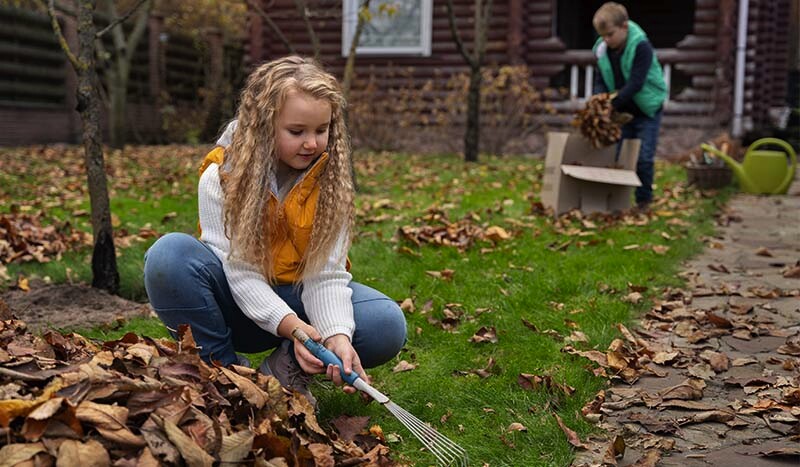
It also makes sense to clean the edges around the house. Leaves that collect right beside the facade retain moisture and can, over time, contribute to dirt, moss or slower drying of surfaces.
Check Outdoor Paths, Steps and the Entrance
A rainy autumn quickly reveals which surfaces around the house become slippery. Moss, algae, wet leaves and mud are particularly unpleasant on steps, ramps, paving stones and wooden decking.
Therefore, clean the paths you use every day: the approach to the front door, the path to the garage, terrace, bins or garden shed. Remove leaves and check whether the paving stones are stable, wooden parts are firm and outdoor steps are undamaged.
At the entrance, it is also useful to create a practical autumn corner. A good doormat, space for wet shoes and umbrellas, and proper outdoor lighting can greatly improve everyday comfort on wet days.